
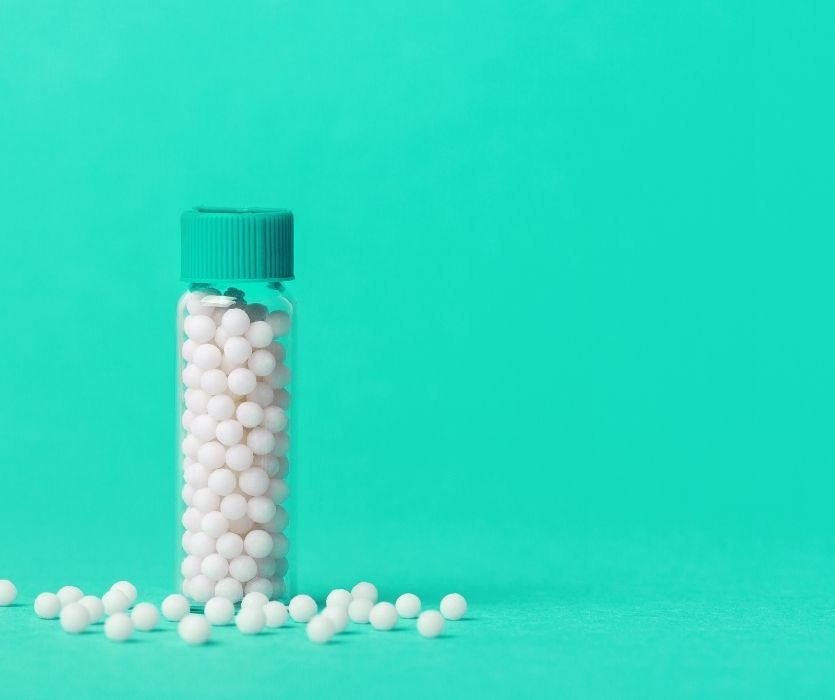
The short answer: Homeopathic baby products are widely sold, but scientific evidence for their effectiveness is weak, and the FDA does not evaluate them for safety or efficacy. Here's what that means for your family.
If you've ever stood in the baby medicine aisle squinting at labels, you've probably noticed that some products are marked "homeopathic" – things like Zarbee's Baby Cough Syrup or Baby Orajel Teething Gel sitting right next to conventional medications. It's not always obvious what that label means, or whether it matters.
As a researcher and child development educator, I dug into the science so you don't have to.
What Is Homeopathic Medicine?
Homeopathy is a philosophy of natural medicine built around two core ideas:
- The body can heal itself. Homeopathic practice focuses on supporting that natural process.
- "Like heals like." If a natural substance causes certain symptoms in a healthy person, giving a very small amount of that same substance to someone with those symptoms is thought to trigger the body's healing response.
Practitioners have been cataloging which natural materials cause which symptoms since the late 1790s, using that knowledge to match treatments to illnesses.
How Are Homeopathic Products Made?
A homeopathic remedy typically starts with a tiny amount of a plant, animal, or mineral ingredient – the active component intended to create the "like heals like" response. That ingredient is then diluted heavily with water and mixed using a specific shaking method. The final product may be sold as a liquid, tablet, or spray.
One notable theory, proposed by the scientist Jacques Benveniste in 1988, suggested that water molecules retain a "memory" of antibodies they once encountered during dilution, which would explain how such highly diluted solutions could still have an effect. That theory has since been largely disproven by the scientific community.
Does the Research Show They Work?
The most comprehensive review to date was conducted by Australia's National Health and Medical Research Council (NHMRC), which examined hundreds of studies on homeopathy. Their conclusion: most studies claiming that homeopathic medications work were poorly designed, had too few participants to be statistically significant, or showed results no better than placebo.
The bottom line: The quality of existing research is too weak to draw firm conclusions either way.
It's also worth knowing that while the U.S. Food and Drug Administration (FDA) does oversee the manufacturing of homeopathic drugs, it does not evaluate them for safety or efficacy – meaning no clinical proof is required for the claims on the label. The Federal Trade Commission has flagged this as a concern, noting that these products may violate advertising guidelines by making health claims without supporting evidence.
Is It Harmless to Just Try Them?
This is a fair question – and one worth taking seriously. The argument is often: they're natural, so what's the harm?
The concern is that "natural" doesn't automatically mean safe or inert. Without rigorous testing, unintended effects can surface only after a product is already in wide use.
A real example: Hyland's Teething Tablets were recalled after reports of severe illness, and in some cases death, in children. Investigators found inconsistent amounts of belladonna – a toxic plant – across individual tablets. While Hyland's maintained that small amounts of belladonna could help relieve gum pain, the FDA took a firm opposing stance, stating: "There is no known safe dose or toxic dose of belladonna in children because of the many factors that affect it." The majority of users did not report problems, but the unpredictability itself is a serious risk factor.
What This Means for Parents
Homeopathic baby products are legal, widely available, and used by many families. You may even know parents who swear by them. But given the gaps in research, the lack of FDA safety review, and real-world examples like the Hyland's recall, it's worth being an informed consumer before reaching for these products.
If your child is ill or in pain, talking to your pediatrician is always the safest first step – they can help you sort through what evidence actually supports.
Related reading: Medicine List for Sick Babies
About the Author: Claire Goss holds a master's degree in child development from Tufts University and has spent 15 years as a parenting and child development educator, researcher, and writer. She is also a mother of three.
Updated February 2026
Leave a Comment