
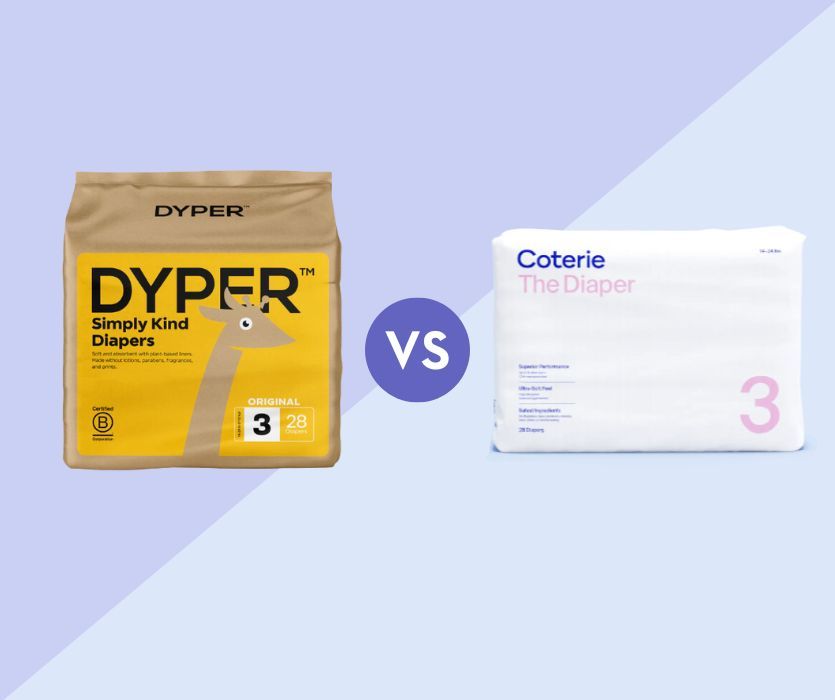
Quick answer: If eco-impact matters most and you're actually willing to commit to a composting subscription, Dyper is the better pick. If you want the better price, near-identical quality, and a diaper designed with newborns in mind, go Coterie. If it just comes down to feel against your baby's skin, that's Coterie for me. Neither will fail you on safety or performance — the real differences come down to chlorine processing (Dyper is ECF, Coterie is TCF), certifications (Dyper alone has OEKO-TEX and DermaTest), composting (Dyper only, via REDYPER), and newborn-specific design (Coterie only). Details below.
When I was pregnant with my first, I was horrified to learn how many billions of diapers end up in landfills every year. I wanted something free of harsh chemicals that also didn't leave me feeling gross about tossing 12 diapers a day in the trash. Back then, good eco-friendly options were scarce. Today, two brands consistently come up when parents ask me for recommendations: Dyper and Coterie. Here's how they actually compare.
A Bit of Background
Dyper was founded in 2018 by Sergio Radovcic, a dad who wanted chemical-free diapers for his daughter that also wouldn't wreck the environment.
Coterie launched in 2019 after founder Frank Yu noticed the high-quality diapers he'd seen in Japan didn't yet exist in the U.S. market.
Materials
Both brands use genuinely high-quality materials. Coterie uses responsibly sourced, plant-based materials with a sustainably sourced wood pulp core, a soft breathable outer layer, and a snug waistband. Dyper uses bamboo, which is highly biodegradable, soft, and hypoallergenic (a good pick for sensitive skin) with stretchable tabs for a fit.
In practice, I think Coterie feels a bit nicer and softer, more like real fabric than a typical diaper. Dyper is still solid and comfortable, and bamboo has real advantages for biodegradability and sensitive skin.
Ingredients
Both are free of fragrances, lotions, latex, dyes, heavy metals, parabens, and harsh chemicals like TBT and phthalates. Both use polypropylene and sodium polyacrylate (SAP) for absorption, and both are dermatologist-tested with no optical brighteners or animal testing.
Where they differ: Coterie is Totally Chlorine Free (TCF), while Dyper is Elemental Chlorine Free (ECF) — meaning chlorine-containing chemicals are still used somewhere in processing the wood pulp.
Dyper's charcoal-enhanced line goes further, using FSC-certified wood pulp with no chlorine, latex, alcohol, TBT, parabens, phthalates, dyes, or fragrances — it's also the first black diaper I've come across, and it's won industry awards for design and performance. Dyper lists polyethylene as an ingredient (for the waterproof barrier); I don't see this on Coterie's site. Dyper is also the only one of the two with independent certification — Standard 100 by OEKO-TEX and DermaTest 5-Star.
Absorbency
Both claim strong overnight protection. Dyper includes a pH wetness indicator; Coterie doesn't. Coterie claims a higher liquid capacity and faster absorbency than competitor brands; Dyper claims roughly double the absorbency of traditional brands.
In practice, sizing matters more than the marketing numbers because a diaper that's even slightly off-fit will leak regardless of brand. Both run a little differently than mainstream brands like Pampers or Huggies, so don't be surprised if you size up sooner than usual (both make size swaps free, so don't be shy about adjusting).
Environmental Impact
Per the FTC's definition, no disposable diaper is truly "biodegradable" the way most people picture it. Coterie focuses on responsibly sourced materials but doesn't offer a composting program. Dyper offers REDYPER, an optional composting add-on.
Subscriptions
Both offer flexible, cancel-anytime subscriptions with easy editing before each shipment. REDYPER, Dyper's composting add-on, has gone through several versions over the years and now runs as curbside pickup. New subscribers get a handful of free pickups, then it's a recurring monthly cost on top of your regular subscription. Availability depends on where you live and has shifted enough over time that I'd check Dyper for current coverage rather than trust any city list, including mine.
Personally, I feel that unless you're genuinely committed to bagging up dirty diapers for a separate pickup, REDYPER is more hassle than most parents want. It's a lovely idea, but it's an extra step, an extra cost, and one more thing to remember in a season already full of things to remember. If you're already composting food scraps meticulously, you'll probably love it. If you're just trying to survive the newborn phase, skip it and don't feel guilty — using Dyper at all is already a lower-impact choice than most mainstream brands.
Where to Buy
- Dyper: Dyper, Amazon, Walmart, Target, Babylist, Grove Collaborative, Whole Foods, Thrive Market
- Coterie: Coterie, Amazon, Walmart, Target, Whole Foods, Wegmans, Babylist
Both brands are now at Target, Walmart, and Amazon, so "which one can I grab in a pinch" isn't really a deciding factor anymore.
A Few More Differences Worth Knowing
Newborn-specific design. Coterie built an umbilical cord cutout and overlapping tabs into their smallest sizes for tiny newborn bodies, plus a "split box" option (part Newborn, part Size 1) since babies outgrow the smallest size so fast. I haven't seen an equivalent from Dyper, so if you're buying before baby arrives, this is a small but real point in Coterie's favor.
Training pants. If you'll eventually use either brand's pull-up style, it's worth knowing Coterie's ("The Pant") tend to perform closer to their regular diaper line in absorbency, while Dyper's have been described as thinner and less absorbent than their own core line.
A fair caveat on "sustainable materials." Coterie markets itself as plant-based and responsibly sourced, but its absorbent core — like most premium diapers, including Dyper's — still relies on sodium polyacrylate, a synthetic polymer. Neither brand has fully solved this; it's an industry-wide limitation, not a strike against either one.
Pricing
Both land in a similar range — roughly $80–$100 a month for a subscription box, or about $0.45–$0.90 per diaper, depending on size and brand. Dyper's charcoal line runs a bit higher, and REDYPER adds an extra monthly cost. A newborn can go through 8–12 diapers a day, so your actual spend in those early weeks will run higher than the "per box" price suggests but that drops as your baby grows. Pricing shifts fairly often for both brands, so treat any number here as a ballpark and check each site directly. Overall, Coterie tends to come out a little cheaper, especially once you factor in REDYPER.
A Quick Note on Reactions
Neither brand's ingredient list is a red flag — both are free of the usual irritants and dermatologist-tested. But every baby's skin is different, and there's no real way to patch-test a diaper brand in advance. When you try a new brand, keep an eye on your baby's skin for the first day or two. A little redness that clears up quickly is common. If you see persistent rash, blistering, or spreading irritation, that's worth a call to your pediatrician.
So, Dyper or Coterie?
Both brands clearly put thought into ingredients, comfort, and construction — you won't go wrong with either. If environmental impact is your top priority and you'll actually use the composting program consistently, Dyper is the better pick. If you're not planning to compost (or already have it available in your area) I'd lean Coterie: it's a little cheaper, has those newborn-specific touches, and it's just the nicer-feeling diaper to me. Dyper is a great diaper in its own right, but Coterie has the edge on softness and that "this doesn't feel like a diaper" quality that's hard to describe until you've tried it.
Ready to try one?
- Dyper: Dyper, Amazon, Walmart, Target, Babylist, Grove Collaborative, Whole Foods, Thrive Market
- Coterie: Coterie, Amazon, Walmart, Target, Whole Foods, Wegmans, Babylist
Related: 7 Diapers as Good as (or Better Than) Pampers
This post may contain affiliate links. If you purchase through my links I may earn a small commission at no extra cost to you. Thanks for supporting Pregnant Chicken — it keeps the lights on and supports our free content. Information accurate as of August 6, 2026.

Leave a Comment