
Quick answer: Carry your crying baby while walking for 5 minutes, then sit and hold them for 5 to 8 more minutes before laying them down. This "5-8 Formula" comes straight out of a 2022 RIKEN Center for Brain Science study in Current Biology, and it's the closest thing we have to a research-backed cheat code for a fussy baby.
It won't work every single time (no baby trick does) but it costs you 13 minutes, and if you're in the trenches of newborn crying, that's a trade worth making.
Table of Contents
- What is the 5-8 Formula?
- The science behind it
- Why laying them down is the hardest part
- Will this work for every baby?
- If it doesn't work, do this instead
What is the 5-8 Formula?
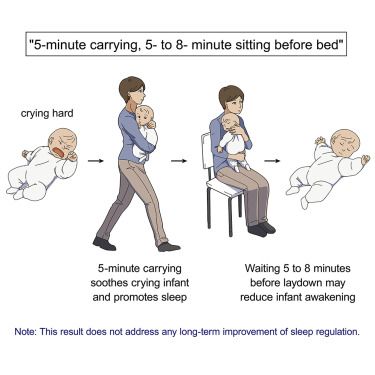
It's four simple steps:
- Pick up your crying baby. Carry them in your arms or a baby carrier — a stroller doesn't seem to trigger the same response.
- Walk for 5 minutes. Steady, continuous motion, not stop-and-go.
- Sit down and keep holding them for 5 to 8 minutes. Don't put them down yet, even if they seem asleep.
- Lay them in the crib slowly and completely — more on why this step trips people up below.
That's it. Thirteen minutes, give or take, and no props required.
The science behind it
Ever notice how your baby stops crying the second you pick them up and start walking? That's not a fluke. It's a real, built-in reflex called the transport response.
Think of it as an automatic "off switch" for distress. It's not just a human thing, either – puppies, mice, and baby monkeys all go still when their mom carries them. It seems to be nature's way of keeping a baby calm and quiet while being moved. You don’t want to be squawking like a rooster at dawn while mom tries to hide you from a saber tooth tiger, right?
Here's what researchers found when they studied this in human babies:
- Carrying works fast. In the study, every single crying baby stopped crying once picked up and walked. Almost half of them fell asleep within just five minutes.
- It targets distress, not just sleepiness. Babies who weren't already crying didn't react the same way. So this isn't a general sleep trick — it's specifically a "calm me down" trick.
- This is a common problem, not a "you" problem. Researchers estimate that 1 in 4 to 1 in 3 babies cry a lot for no clear medical reason. If that's your baby, you're not doing anything wrong.
Why does it work? Carrying flips on your baby's "rest and digest" mode — the same system that kicks in when we relax. It slows the heart rate and pulls their whole body out of panic mode.
Why sit for 5 to 8 more minutes instead of putting them down right away? Babies drift into a light stage of sleep before settling into a deeper one. In that light stage, almost anything can wake them — a creaky floor, a shifted arm. A few extra minutes of holding helps them sink past that easily-woken stage before you attempt the crib.
Why laying them down is the hardest part
You know this feeling: your baby is finally asleep, and somehow they still wake up the second their back touches the mattress.
Here's the surprising twist the study found: it's usually not the landing that wakes them up. It's the moment you start letting go. Babies were most likely to stir right as a parent began pulling their arms away and not once the baby actually reached the mattress. So the risky moment isn't "putting them down." It's the in-between moment of half-holding, half-not.
Even the lead researcher expected it to come down to gentleness or posture. She was surprised to find it was really about that in-between moment of letting go.
What this means for you: when you go to lay your baby down, don't ease out slowly. Commit to the motion and finish it in one smooth go. A slow, hesitant pull-away seems to wake babies up more than a quick, complete release does.
Will this work for every baby?
Realistically, no. Some babies have clearly decided that crying works just fine without a saber-toothed tiger in the equation, transport response or not.
I birthed what I can only describe as a bedtime banshee, and even I'll say: something that only asks for 13 minutes of your time is worth trying before you write it off. Worst case, you've walked your steps for the day. Best case, everyone's asleep 13 minutes from now.
If it doesn't work, do this instead
- Put the baby down somewhere safe. A few minutes of crying in the crib won't hurt them, and it gets you a breather.
- Tag someone else in if you can. Point (not that finger — the other one) and hand off the reins for a bit.
- Get physical distance. Headphones, a short walk, a glass of water, a snack. You can't pour from an empty cup, and an overwhelmed nervous system doesn't soothe a crying baby any better than a calm one does.
- Zoom out to longer-term sleep habits. The 5-8 Formula is a right-now tool, not a sleep-training plan. For the bigger picture, here's a full overview of newborn sleep strategies.
If the crying seems truly relentless and you're worried about your own reactions in the moment, this is worth a read too — you are not the only parent who has felt pushed to the edge, and there's no shame in needing backup.
Did you try it?
Tell us in the comments if the 5-8 Formula worked for your kiddo!
Next up: The Witching Hour: How to Handle Your Newborn's Evening Fussiness
Source: Ohmura, N., Okuma, L., Truzzi, A., et al. "A method to soothe and promote sleep in crying infants utilizing the transport response." Current Biology, 32(20), 4521-4529 (2022).


Leave a Comment