
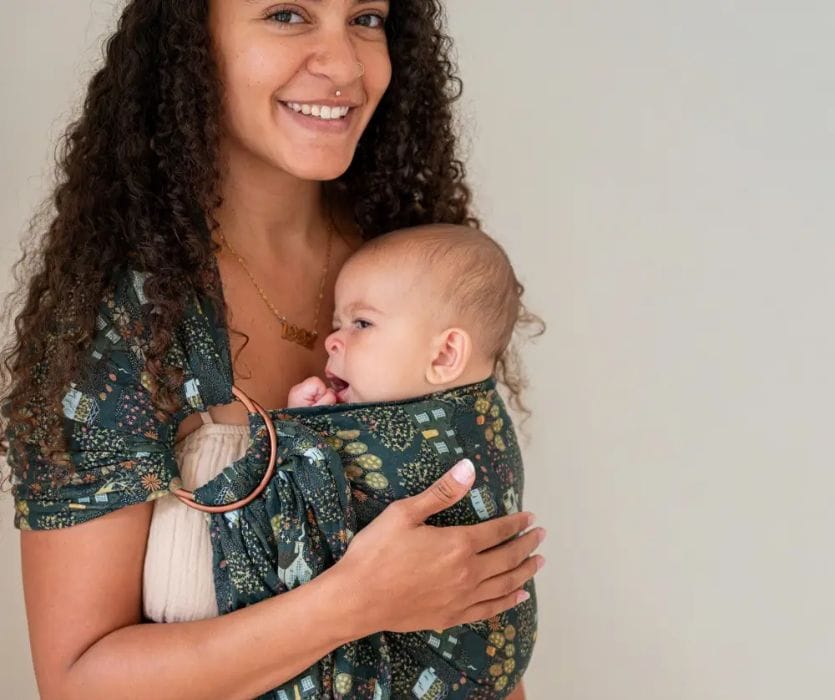
If there's one carrier that consistently surprises parents who try it, it's the ring sling. It looks deceptively simple – just a length of fabric threaded through two rings – and yet it's the carrier that ends up living permanently in most diaper bags, long after the stretchy wrap has been retired and the buckle carrier is reserved for longer outings.
It works for newborns. It works for toddlers. It goes through airport security without making you completely dismantle yourself. And it rolls up small enough to stuff into a corner of whatever bag you're already carrying.
Here's what you need to know.
What you'll find here:
- What a ring sling actually is
- How to wear your baby in one
- Age and size range
- Honest pros and cons
- How to know if this is the right type for you
- A note on heat and fabric choices
- Brands worth knowing about
What Is a Ring Sling?
A ring sling is a single length of fabric with two rings sewn into one end. You thread the fabric through the rings to create an adjustable pouch that holds your baby against your body and is worn over one shoulder.
The adjustment happens entirely through the rings, which means no tying, no buckling, and no pre-wrapping. You thread it, put the baby in, pull the fabric tails to tighten, and you're done. Once you get the hang of it, it genuinely takes about 15 seconds.
Ring slings come in a wide range of fabrics — linen, cotton, hemp, silk, woven wrap fabric — and that choice matters more than it might seem. More on that below.
How Do You Wear Your Baby in One?
Ring slings are worn over one shoulder, with the rings sitting near your collarbone on that side. The fabric spreads across your back and the pouch holds baby against your front or hip.
The main positions are:
Front carry, facing in — Baby faces your chest, knees higher than bottom, head at or above your collarbone. This is the primary newborn position and works beautifully for sleeping babies.
Hip carry — Baby sits on your hip, facing forward or slightly inward. This becomes a favorite position once baby has good head control, usually around 4–6 months. It's one of the most natural feeling carries and lets baby see everything while staying close to you.
Cradle carry — Baby lies horizontally across your body. This position is worth approaching with extra caution — it requires precise positioning to keep baby's airway open, and some babywearing educators advise against it entirely due to airway concerns. If you want to try a cradle carry, get a fit check from a certified babywearing educator before doing so independently.
Most ring slings don't support back carries. If back carrying is a priority, a different carrier type will serve you better.
What Age and Size Can Use One?
This is one of the ring sling's genuine strengths — it truly does grow with your baby. A well-adjusted ring sling works from newborn through toddler, often well past 30 pounds. The adjustment is infinitely variable, which means it accommodates a tiny newborn just as well as a squirmy two-year-old who wants to be up and down every five minutes.
The one-shoulder design does become more fatiguing as your baby gets heavier, which is why most parents transition to a two-shoulder carrier for longer carries with older babies. But for shorter outings, quick ups and downs, and hip carries, many parents use their ring sling regularly well into toddlerhood.
The Honest Pros and Cons
What ring slings do really well:
They're fast. Once you know what you're doing, a ring sling goes on in seconds. There's nothing else in babywearing that matches it for speed.
They're compact. A ring sling folds or rolls into almost nothing. It lives in the bottom of a diaper bag, a tote, a stroller basket — wherever you need it. This makes it the carrier most parents actually have on them when they need it unexpectedly.
They grow with your baby. The infinite adjustability means one ring sling genuinely works from newborn through toddler. You're not buying a newborn carrier and a toddler carrier — you're buying one thing.
They're great for nursing. Many parents find ring slings the easiest carrier type for breastfeeding on the go. The fabric adjusts to lower baby into position and then back up when done, without removing the carrier.
They work beautifully in heat. A single layer of linen or cotton in a ring sling is about as cool as babywearing gets. This is a meaningful difference from a stretchy wrap or padded buckle carrier in hot weather.
Where they fall short:
One shoulder carries all the weight. This is the ring sling's fundamental limitation. For short carries, it's completely fine. For longer outings with a heavier baby, it gets tiring — and if you don't spread the fabric across your shoulder and back properly, it can strain your neck.
There's a learning curve. Not as steep as a woven wrap, but real. Getting the fabric spread correctly, the rings in the right position, and the tightening technique down takes practice. Many parents try a ring sling once, decide it doesn't work, and give up before they've actually learned it. A fit check or an in-person demo makes an enormous difference.
TSA procedures vary. Be prepared to remove your baby from the carrier at security screening. Whether the carrier itself needs to come off depends on the screening method used. Check current TSA guidelines before you fly rather than assuming either way.
Fit is genuinely individual. Ring slings fit differently on different body types, and fabric choice affects how easy they are to learn with and adjust. A sling that a friend loves might not work as well on your body or with your baby.
A Note on Fabric: This Actually Matters
More than almost any other carrier type, the fabric of a ring sling affects how it performs. Here's the quick version:
Linen and cotton are the most recommended starting points. They're breathable, relatively easy to adjust, and hold their position well once tightened. Linen especially is a top choice for warm climates — it gets softer with washing and wears beautifully.
Hemp blends (often hemp-cotton) are durable, supportive, and also great in heat. Slightly more texture than linen, which some parents love and some find scratchy at first.
Woven wrap fabric ring slings are made from the same material as woven wraps — usually a cotton or linen blend in a specific weave. These tend to be the most supportive and are highly adjustable, though they can be stiffer when new and need a break-in period.
Silk is incredibly lightweight and beautiful but slippery, which makes it harder to learn with and harder to keep adjusted. Generally not recommended as a first ring sling.
Muslin is soft and lightweight — great for newborns and warm weather, but less supportive as baby gets bigger.
The general advice from experienced babywearers: start with a linen or cotton ring sling for ease of learning, then branch out once you know what you like.
Is a Ring Sling Right for You?
Go for it if:
- You want something fast and packable for quick outings
- You're in a hot climate and want a cool carrying option
- You plan to nurse on the go
- You want one carrier that genuinely works from newborn to toddler
- You'll be in situations where quick ups and downs matter — grocery runs, chasing a toddler, travel
Maybe look elsewhere if:
- You have significant shoulder or neck issues
- You primarily need a carrier for long carries with a heavy baby
- Back carrying is a priority
Brands Worth Knowing About
Hope & Plum Consistently one of the most recommended ring sling brands in parent communities. Their hemp-cotton blend is supportive, breathable, and gets softer with use. They offer free fit consultations, which is genuinely useful when you're learning. On the pricier side, but worth checking their secondhand platform if budget is a concern. Check them out on the Hope & Plum site.
LoveHeld Comes up frequently as a favorite, particularly their waffle weave fabric which many parents find easier to learn with than traditional woven options. Beautiful designs and a supportive carry. A strong contender if you want something slightly different from the standard linen sling. Find them on their site.
Sakura Bloom A well-established brand with a loyal following. Their linen ring slings are widely loved for their simplicity and quality. You can find them on the Sakura Bloom site.
Girasol A popular recommendation for beginners specifically because of their gradient fabrics, which make it easier to see where to pull when tightening. Generally more affordable than Hope & Plum or LoveHeld, but they are a little tricky to find in North America but a lot of specialty stores carry them. You can check them out on their site.
Wildbird Widely available in mainstream baby stores, which makes them accessible if you want to try a ring sling without ordering online. Mixed reviews in experienced babywearing communities compared to the brands above, but many parents use them happily — particularly for casual use. You can find them on the Wildbrid site.
LennyLamb Their ring slings use woven wrap fabric and are highly regarded for support and longevity. A good option if you want to eventually move into woven wrap babywearing and want your ring sling to feel similar. Find them on the Lenny Lamb site.
Before You Buy
Ring slings are one of the best carrier types to buy secondhand — there's no hardware to wear out, and a gently used sling in good quality fabric is just as good as new. Check for any thinning in the fabric or distortion around the rings before buying used.
If you try a ring sling and struggle with it, please get a fit check before deciding it's not for you. The most common issues — fabric not spread across the shoulder, rings in the wrong position, tightening from the wrong section of fabric — are all fixable with a small adjustment and make the difference between a carrier that hurts and one that feels effortless.
The Full Series
- Overwhelmed by Baby Carriers? Here's Where to Actually Start
- The Beginner's Guide to Soft Structured Carriers
- Stretchy Wraps Are Magic for Newborns — Until They're Not
- Beyond the Buckle: A Guide to Woven Wraps and Meh Dais
- What Is an Onbuhimo? Everything You Need to Know About This Underrated Carrier
- Just Tell Me Which Carrier to Buy: A Practical Guide for Overwhelmed Parents
This post may contain affiliate links. If you purchase through my links I may earn a small commission at no extra cost to you. Thanks for supporting Pregnant Chicken — it keeps the lights on and supports our free content. Updated February 2026.
Leave a Comment