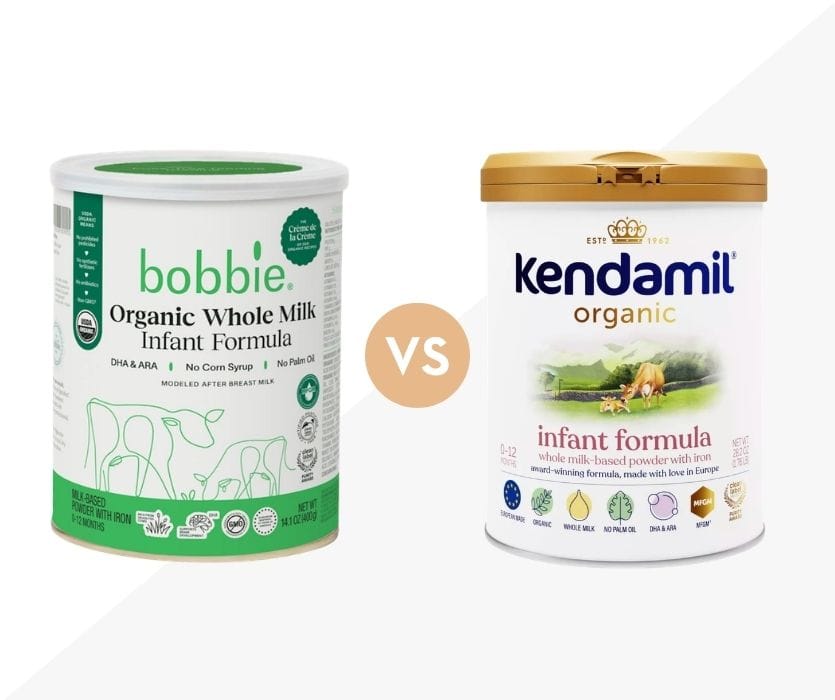
If you've narrowed it down to Bobbie Organic Whole Milk and Kendamil Organic, you're comparing two of the closest things to breast milk you can buy off a shelf – both are organic, whole-milk-based, and built around the same 60:40 whey-to-casein ratio found in mature breast milk. The real differences come down to how much of the formula is whole milk, whether prebiotics are added, and price.
Quick answer: If third-party contaminant testing and US manufacturing matter most to you, Bobbie Organic Whole Milk is the stronger pick. If you want added prebiotics and a slightly lower price per ounce, Kendamil Organic is the better fit. Neither is "healthier" in any meaningful sense – they're just built differently.
Below is the full breakdown to help you figure out which one is right for you.
Table of Contents
- Quick Comparison Table
- Milk Base: The Core Difference
- Ingredients and Nutrition
- Digestion: What the Ingredients Suggest
- Taste and Texture
- Certifications and Manufacturing
- Price Comparison
- Where to Buy
- How to Actually Switch Formulas
- FAQs
- Bottom Line
Quick Comparison Table
Bobbie Organic Whole Milk compared to Kendamil Organic
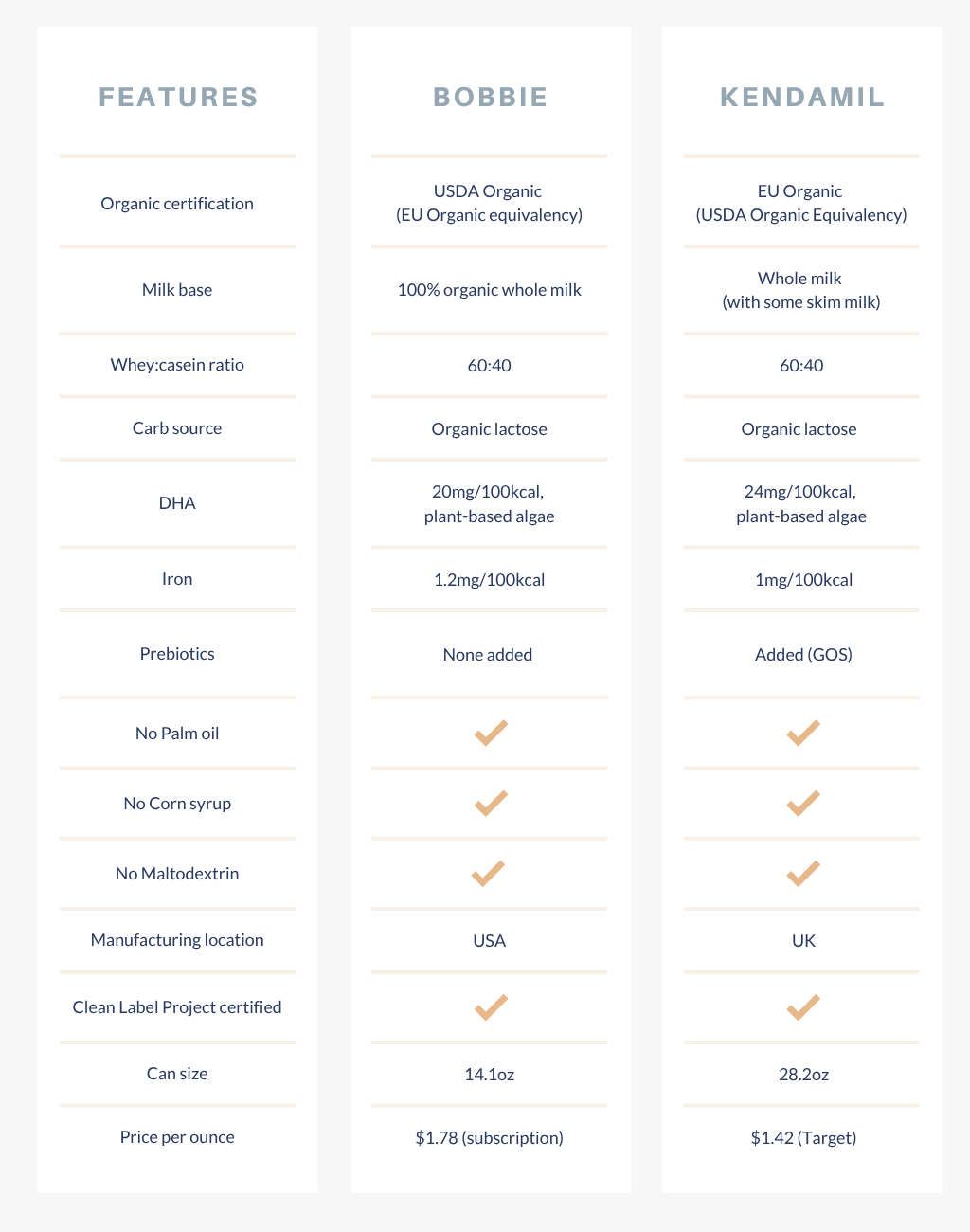
Prices and formulations change periodically, so double-check current pricing on Target.com or the brand's site before you buy.
Milk Base: The Core Difference
Both formulas lean on whole milk rather than the nonfat/skim base some formulas use, which means more naturally occurring milk fat and less reliance on added vegetable oils. The distinction between them is how much of that milk is actually whole: Bobbie uses 100% organic grass-fed whole milk, while Kendamil Organic blends whole milk with some skim milk. In practice, that gives Bobbie a slightly higher proportion of naturally occurring milk fat, including MFGM (milk fat globule membrane), a component also found in breast milk and linked to brain development support.
Sourcing differs too. Bobbie's organic whole milk comes from grass-fed cows in New Zealand, with its lactose and whey sourced from organic family farms in the US. Kendamil Organic's milk comes from grass-fed cows on family farms in the UK, sourced locally to its factory in Kendal, in the Lake District
Ingredients and Nutrition
Both formulas use organic lactose as the sole carbohydrate, both use plant-based DHA sourced from algae rather than fish oil (so neither has a fishy smell or carries mercury exposure risk), and both skip palm oil, corn syrup, and maltodextrin entirely.
Kendamil Organic contains GOS (galacto-oligosaccharides), a prebiotic fiber intended to support gut bacteria and digestion.
Bobbie doesn't add prebiotics to any of its formulas. Instead, it points to two things: the naturally occurring MFGM from its whole milk base, and the fact that its formula is 100% lactose, which it markets as having some natural prebiotic-like properties, though that works through a different mechanism than added GOS. Babies who might need an additional gut health boost can add their Organic Probiotic Drops.
Bobbie sits at 20 mg of DHA per 100 kcal, meeting the EU minimum. Kendamil Organic provides 24 mg of DHA per 100 kcal, according to Kendamil's own clinical materials, which state this exceeds EFSA's 20 mg requirement.
Digestion: What the Ingredients Suggest
Neither brand has published head-to-head digestion studies against the other, so this is ingredient-based reasoning rather than a guarantee. Every baby's gut responds differently, and persistent reflux or distress is worth raising with your pediatrician rather than solving through label-reading alone.
Both formulas' whole-milk bases are designed to be gentler than older nonfat-and-added-oil formulas, with naturally occurring fats some parents find easier to digest and that may support softer stools. Kendamil's added GOS is specifically marketed for gut health support; Bobbie's MFGM is marketed primarily for brain development, with digestive ease attributed more broadly to its whole-milk, lower-added-oil composition.
In practice, this means there's no clear ingredient-based winner on digestion between these two. It's genuinely a trial-and-observe situation.
Taste and Texture
Both are whole-milk-based, so expect a richer, creamier texture from either than you'd get from a nonfat formula, which is closer to what many parents describe as a "real milk" taste. Because neither uses fish oil, neither should have the faint fishy taste or smell some formula brands carry. Beyond that, taste preference comes down to the baby; there's no reliable way to predict which one a given baby will prefer before trying it.
Certifications and Manufacturing
Manufacturing location and testing philosophy are really where these two diverge.
Bobbie's US-based production and third-party testing (Clean Label Project, Light Labs, the botulism screening) appeal to parents who want an outside lab verifying every claim.
Kendamil's UK manufacturing is backed by 60+ years of production experience, and it shipped steadily enough during the 2022 shortage to enter the US market and help fill gaps for American families. Kendamil's US-market formula has not been subject to a recall in the United States. The February 2026 recall in Canada due to cereulide toxin contamination did not affect product sold in the US.
If you weigh third-party verification heavily, that favors Bobbie; if you weigh a long, uninterrupted production track record and in-house testing at scale, that favors Kendamil.
Price Comparison
Pricing varies by retailer and whether you're buying via subscription, so treat these as ballpark figures as of July 2026:
- Bobbie Organic Whole Milk: roughly $1.79/oz with a subscription (around $25.20/can subscription, from $28.99/can retail)
- Kendamil Organic: roughly $1.42/oz at Target ($39.99 for a 28.2oz can)
Kendamil's larger can (28.2oz vs. Bobbie's 14.1oz) is a big part of why it lands cheaper per ounce. It's also worth noting that Bobbie offers an automated subscription with built-in discounts, while Kendamil is currently retail-only in the U.S.
Where to Buy
Bobbie Organic Whole Milk is sold at Target, Whole Foods, Walmart, Meijer, Wegmans, Thrive Market, Amazon, Costco, and Bobbie's own subscription service, which also includes perks like free sessions with lactation and feeding experts for subscribers. Kendamil Organic is sold at Target, Walmart, and Amazon, and through various formula subscription retailers online.
How to Switch Formulas
If you're moving from one to the other (or from breast milk to either) the general approach most pediatricians recommend is a gradual transition: start around 25% new formula mixed with 75% of the current one, then shift the ratio over several days while watching for changes in stool, fussiness, or spit-up. Mixing the two formulas together in the same bottle isn't recommended, since each is formulated to be nutritionally complete on its own; if you want to compare them, alternate by bottle instead.
FAQs
Is Bobbie or Kendamil Organic easier to digest? Neither has published comparative digestion data. Both use whole-milk bases designed to be gentler than older nonfat formulas; Kendamil adds GOS prebiotics specifically for gut support, while Bobbie relies on its 100% whole-milk composition and naturally occurring MFGM. This comes down to trial and observation with your own baby.
Does Kendamil Organic or Bobbie Organic Whole Milk taste more like breast milk? Both are whole-milk-based and tend toward a richer, creamier taste than nonfat formulas. There's no meaningful taste difference reported between the two beyond ordinary can-to-can or baby-to-baby variation.
Can I switch between Bobbie Organic Whole Milk and Kendamil Organic? Yes, with a gradual transition and pediatrician guidance (see the switching section above). Avoid mixing them in the same bottle.
Are both FDA compliant? Yes. Bobbie is manufactured in the U.S. under FDA regulation. Kendamil transitioned from temporary FDA Enforcement Discretion status (granted during the 2022 shortage) to permanent FDA-compliant status for its U.S.-market formula, which is separate from its UK-only product lines.
Bottom Line
Bobbie Organic Whole Milk and Kendamil Organic are both well-formulated, organic, whole-milk-based options with the same protein ratio as breast milk and none of the ingredients most parents are trying to avoid. Whichever you choose, give it a real trial window before ruling it out, and loop in your pediatrician if anything seems off.
Find out more at hibobbie.com and us.kendamil.com
Have questions about formula feeding or your own experience to share? Drop a comment below.
Next read: How to Switch Baby Formula: Creating a Smooth Transition
This post may contain affiliate links. If you purchase through my links I may earn a small commission at no extra cost to you. Thanks for supporting Pregnant Chicken — it keeps the lights on and supports our free content. Information accurate as of August 5, 2026.
Sources
- Bobbie Organic Whole Milk Infant Formula — Product Page
- Bobbie Launches the First and Only USDA Organic Whole Milk Infant Formula Manufactured in America — Bobbie press release, April 2025
- Kendamil Organic First Infant Milk — Product Page
- Kendamil Organic First Infant Milk — Healthcare Professional Reference
- Bobbie — Home
- Kendamil USA — Home
- Target.com — pricing for Bobbie Organic Whole Milk and Kendamil Organic, verified July 2026


Leave a Comment