
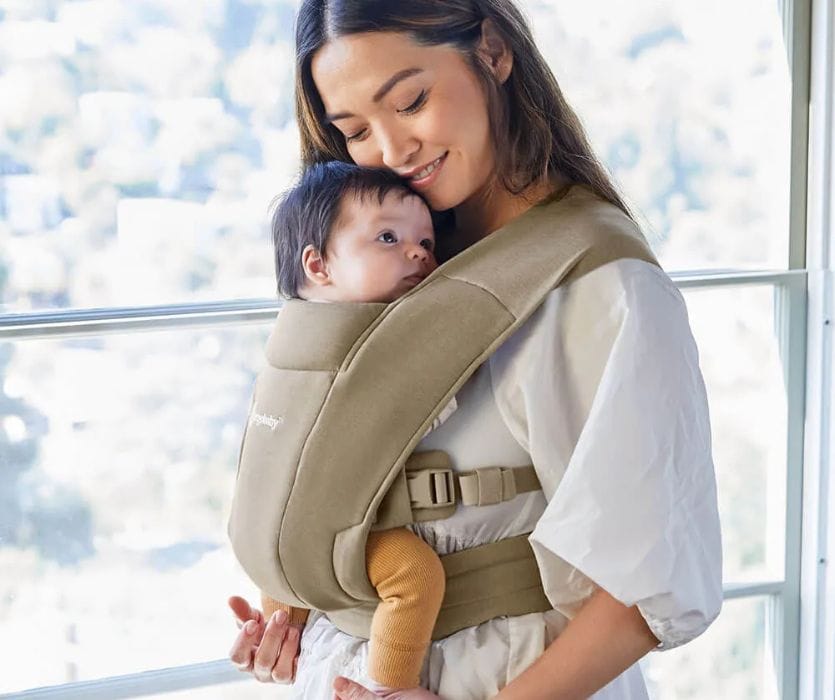
Congratulations, you've discovered babywearing, and also the approximately 4,000 opinions that come with it. If you've spent any time googling carriers, you've probably ended up more confused than when you started, questioning whether you need a ring sling, a structured carrier, a wrap, or all three. (Spoiler: you don't need all three. At least not yet.)
Here's the good news: babywearing doesn't have to be complicated, and you don't need to have it figured out before your baby arrives. This guide will walk you through what babywearing actually is, why so many parents swear by it, and how to take your first step without spiraling into a $300 carrier purchase you regret.
What you'll find here:
- What babywearing actually is
- Why parents love it
- The types of carriers (just enough to know what you're looking at)
- The single most important thing to do before buying anything
- What to realistically expect in the first weeks
What Is Babywearing?
Babywearing is exactly what it sounds like: carrying your baby close to your body using a carrier, wrap, or sling instead of your arms. Humans have been doing this for thousands of years across virtually every culture in the world.
In practice, it means your hands are free while your baby is snuggled against you, soothed by your movement and heartbeat, and genuinely content. It's one of those things that sounds nice in theory and then turns out to be a genuine lifesaver at 3 pm when your baby will only sleep on you, and you still haven't eaten lunch.
Why Do Parents Love It?
The benefits you'll read about on carrier websites — bonding, reduced crying, supporting development — are real and well-supported. But here's what parents actually say when you ask them in the trenches:
It soothes babies in a way almost nothing else does. Newborns have spent nine months being held, rocked, and hearing your heartbeat. A carrier replicates that environment in a way a bouncer or bassinet simply can't. Many parents describe it as their secret weapon for the witchy hour or nap contact sleeping.
It buys you back the use of your body. Whether you're chasing a toddler, making dinner, or just trying to drink a cup of coffee, a carrier means you can actually do those things while keeping your baby happy and close.
It's often easier than a stroller. Navigating cobblestones, public transit, crowded stores, or an airport with a newborn in a stroller is genuinely hard. A carrier keeps you mobile and your hands free in a way a stroller can't always match.
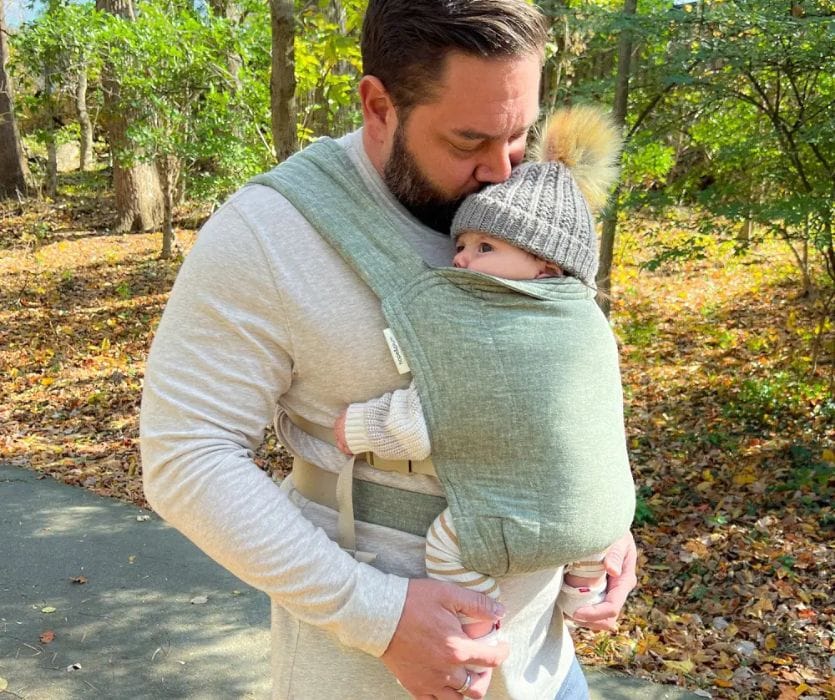
It matters for partners too. Babywearing isn't just for the primary caregiver. Many partners describe it as one of the primary ways they built their early bond with their baby – especially in those first weeks when breastfeeding can make it harder to feel equally connected.
The Types of Carriers: A Quick Orientation
Before you can choose a carrier, it helps to know what you're even looking at. There are five main types, and each has its place. We'll go deep on each one in this series, but here's the quick version so you're not completely lost when someone mentions a meh dai or an onbuhimo.
Stretchy wraps are long pieces of knit fabric you tie around yourself and your baby. They're wonderfully snuggly for newborns and one of the most affordable options. The tradeoff is that they have a learning curve and they become less supportive once your baby hits around 15 pounds. Think of them as a newborn-stage carrier. Brands you'll hear mentioned: Solly Baby, Boba Wrap, Moby.
Woven wraps are also long pieces of fabric, but woven rather than knit, which means they don't stretch. They're more versatile than stretchy wraps, can be used from newborn through toddler, and can do back carries (but they have the steepest learning curve of any carrier type). Worth knowing about, even if they're not your first stop.
Ring slings are a single length of fabric threaded through two rings, worn over one shoulder. They're fast to put on and take off, incredibly compact (they roll up into almost nothing), and brilliant for quick ups and downs. They're a favorite for the newborn stage and for toddlers alike. The one-shoulder design can get tiring for longer carries, but for many parents a ring sling becomes the carrier that lives in the diaper bag permanently.
Soft structured carriers (SSCs), sometimes called buckle carriers, are what most people picture when they think "baby carrier." A padded waistband, shoulder straps, and buckles – similar in principle to a hiking backpack. They're easy to put on, easy to share between wearers, and very comfortable for long carries or heavier babies. This is where brands like Ergobaby, Tula, Kinderpack, Hope & Plum, and Lillebaby live.
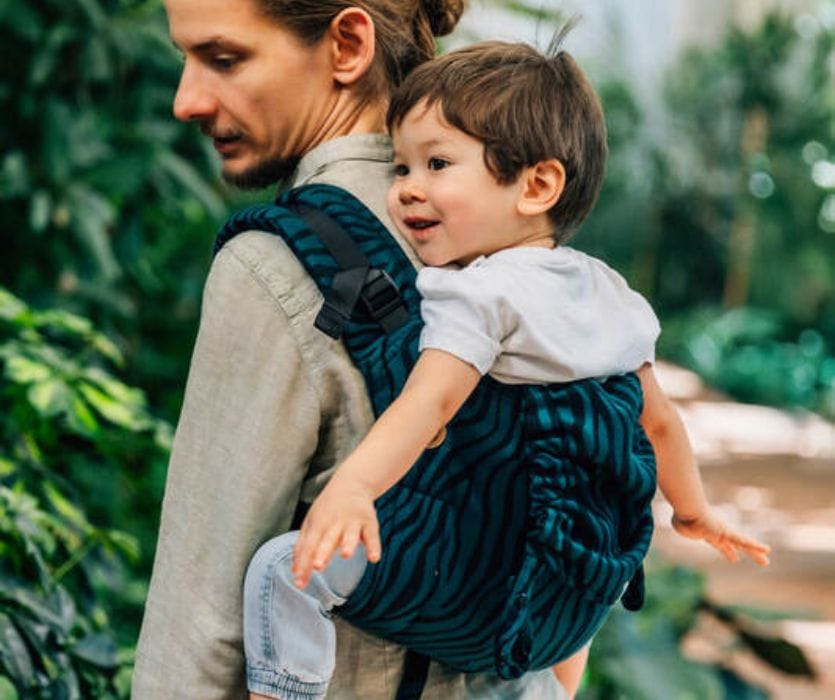
Meh dais and onbuhimos are less commonly known but worth mentioning. A meh dai is a rectangular panel with fabric straps – kind of a halfway point between a wrap and a buckle carrier. An onbuhimo is a back carrier with no waistband, which makes it fantastic for warmer weather, for back carries with older babies, and surprisingly comfortable during pregnancy. We'll cover both in their own posts in this series.
The Single Most Important Thing to Do Before You Buy Anything
Try before you buy.
This sounds obvious but it's genuinely underutilized. Carriers are like jeans: the one that looks perfect on someone else might gap, pinch, or just feel wrong on your body. A carrier that a friend raves about might sit on a buckle right at your hip bone, or have shoulder straps that are slightly too long even at their tightest.
The best way to find what works for you is to try multiple carriers on your actual body, ideally with a real baby or a weighted doll. Here's how to do that without spending a fortune:
Look for a local babywearing group. Meetings are typically free, and many have lending libraries where you can borrow a carrier for a month. You'll also get hands-on help from trained volunteers – which is worth a lot when you're figuring out a woven wrap for the first time.
Check for an online lending library or try-before-you-buy program. If you're in a rural area or can't get to a meeting, several companies and community programs ship carriers to try. Little Zen One is one example that comes up frequently.
Buy secondhand strategically. Baby carriers hold their value remarkably well and the secondhand market is huge – Facebook groups, Mercari, Poshmark, and brand-specific resale platforms like Hope & Plum's Treet. Buying used lets you try something without the full financial commitment, and if it doesn't work for you, you can resell it for close to what you paid.
Use retailers' return windows thoughtfully. If you're truly unable to try anything in person, ordering from a retailer with a generous return policy lets you experiment at home. Just be honest with yourself about actually returning things that don't work.
What to Realistically Expect in the First Weeks
A few things worth knowing before you dive in, because the community posts are full of parents who wish someone had told them these things earlier:
Most parents end up with more than one carrier, and that's completely normal. It's not a failure to try something and realize it's not the right fit for every situation. Many parents have a ring sling for quick errands, a stretchy wrap for newborn naps, and a buckle carrier for longer walks. You don't need all of these on day one, but don't feel like you've done something wrong if your first carrier isn't your forever carrier.
Babywearing will always be a little warm. No carrier is truly cool. Natural fibers like linen, cotton, and hemp are meaningfully better than synthetic materials or heavily padded carriers in hot weather, but you and your baby will still share body heat. This is worth knowing before you spend extra on a "mesh" carrier hoping it will solve the heat problem – all-mesh synthetic carriers are often counterintuitively hotter than a single layer of linen.
There is a learning curve, and that's okay. Nearly every parent describes their first attempts at any carrier as awkward. Ring slings slip. Wraps don't tighten right. Buckle carriers have more adjustment points than expected. This is normal and it gets much easier very quickly. A fit check (either in person at a babywearing group or posted to an online community) can make an enormous difference when something feels off.
Your baby's opinion matters, and it may change. Some babies take to carriers immediately. Some protest for the first few tries and then become converts. Some go through phases of loving and hating the same carrier. It's not necessarily a reflection of the carrier or your technique. Keep trying, adjust the fit, and ask for help.
If you're pregnant and trying to figure out what to register for, the most honest advice is this: start with one carrier for the newborn stage, keep your budget flexible, and plan to reassess around three to four months when your baby's size and preferences become clearer. You don't need to have the full system figured out before they arrive.
The Full Series
- The Beginner's Guide to Soft Structured Carriers
- Stretchy Wraps Are Magic for Newborns — Until They're Not
- Ring Slings: What They Are, How They Work, and Why Parents Love Them
- Beyond the Buckle: A Guide to Woven Wraps and Meh Dais
- What Is an Onbuhimo? Everything You Need to Know About This Underrated Carrier
- Just Tell Me Which Carrier to Buy: A Practical Guide for Overwhelmed Parents
This post may contain affiliate links. If you purchase through my links I may earn a small commission at no extra cost to you. Thanks for supporting Pregnant Chicken — it keeps the lights on and supports our free content. Updated February 2026.
Leave a Comment